
Dracula by Bram Stoker
Camaraderie in a gothic nightmare.

The verdict
Rating: 🌕🌕🌕🌕🌕
Suitable for:
Teenagers who have reached some maturity—some parental discussion warranted
Young adults
Adults
Style and language
I’m a sucker for found footage films, and I suppose a collection of diary entries, letters, telegrams, and newspaper clippings like that which comprises Bram Stoker’s Dracula is the closest that we can expect to get to that experience in a literary format. I was simply not expecting this format in a work of the late 1800s, and it proved a pleasant surprise.
However, Stoker is not the founder of this style, with the famous work of epistolary fiction, Frankenstein, by Mary Shelley predating Dracula by over 80 years, and Horace Walpole commonly thought of as the pioneer of gothic fiction 130 years prior with his work The Castle of Otranto which is in the style of a found manuscript.
The epistolary style of fiction was also not fashioned during the birth of Gothic fiction – some examples predate the Common Era – nor was Stoker’s the first known tale of vampires in fiction of the modern era.
Regardless, since the onset of Gothic fiction, found documents have been the format of choice to deliver the narrative, and Stoker was one of a handful of key writers who helped propel Gothic horror, epistolary, and found-accounts styles of fiction into the phenomenon they have become in contemporary media, and he executed them brilliantly.
The book starts with a paragraph-long explanation of the effort and approach used to compile the text before the reader, so from the very first page the imagination is triggered and the investigative faculties are ignited. I found myself with a hyper-attention to detail like names and places from the very first pages of the novel, as if I were trying to piece together a century – or perhaps centuries – old mystery, though I didn’t yet know the purpose of the investigation.
To me, this was reminiscent of the marketing that surrounded the horror film The Blair Witch Project, which acquired a cult status helped largely by its early internet viral marketing campaign, which sold the belief that this was perhaps really found footage. I imagine the initiatory paragraph in Dracula would have a similarly encouraging effect on readers’ suspension of disbelief when it was published in 1897, rendering Dracula all the more eerie.
The richness of language on display is pleasant to read and at times also pleasant to grapple with, and places the reader within a certain stratum of 1890s society that had the education required to think their words through before speaking and articulate themselves in layers of meaning. I believe this may be due to the remaining influence of classical education in that era (for those who could afford education, of course), but that is the topic of another newsletter article 🤐
This novel offers a glimpse of old aristocratic and upper-class discourse. Dialogues between the main characters are embellished with all the grammatical fineries that you might expect for the age. That style of English often utilised a very roundabout way of expression to soften the impact of speech, and Stoker’s characters use a lot of pleasantries in their normal speech, adding richness to their daily discussion.
Stoker’s character, Van Helsing, is the lead driver of the plot whose long and frequent paragraphs of exposition are a heavy read indeed. Yet for the most part, the language of our upper-class and educated main characters remains quite intelligible—not old enough to mandate a dictionary companion. I was generally surprised with how similar the lexicon of over 100 years ago is to contemporary literature. New words still felt familiar, so searching them up in a dictionary was more so a matter of intrigue. But the same is not true of the side characters and extras.
The main characters stood in stark contrast to the common and working-class people of Whitby and London, who, from my 21st century perspective, seemed to lack a good degree of education and, subsequently, etiquette; though the degree to which Stoker may have exaggerated or stereotyped their dialogues is unknown to me, and I stand to be corrected.
I’m not sure which accents Bram Stoker was trying to replicate with some of these evidently working-class side characters and extras in Whitby and London, but some of those passages are downright unreadable, or at least unintelligible to me. Th're 'r 'oo m'ny ap'str'phees to ma’ ou’ wuts bein’ said, and these passages can be lengthy to add to the challenge of reading this older work.
Oddly, the main characters, even the foreigner Van Helsing of exemplary pedagogy and high diction, seemed to understand what these people were saying without fault, whilst I only managed to catch about 50% of what was being said in these sections and was reliant on the responses of our main characters to fill in the gaps. That could be another sign that such speech was a norm in late 19th century England.
Impressions
Overall
The story had me hooked during a flight to India, and I found myself searching for scraps of spare time on a busy holiday to squeeze in some more reading—which I found at 6am in the morning. In fact, it wasn’t until near the end of the book that I had realised I was reading a children’s abridged version, but it didn’t dishearten me at all because by this time I had grown to appreciate the story a lot, and the challenge gave me an excuse to start the novel once again and experience it in full. I enjoyed it even more the second time!
I knew within the first few chapters that Dracula would make it into one of my favourites, and although I haven’t read much horror before and am relatively new to exploring classics of English literature, it left a good impression of the Gothic fiction genre. Gothic horror has found its way into my “to read” list and I will attribute the start of this fascination with Dracula.
Transylvania was richly described, packed full of colliding histories, cultures, and civilisations, and sprinkled with a good dose of superstition, but I enjoyed the detailed descriptions of Whitby and locations in London even more. It was lovely to see Hampstead Heath and other familiar locations in London featured in the novel, as well as the description of Whitby Harbour and its lighthouse that rings true to this day.
Having recently been to picturesque Whitby myself and having seen the ruins and the church described in the Mina’s accounts, and perhaps even having even sat on one of the very benches that she and Lucy supposedly sat on as they overlooked the town of Whitby, was a truly unexpected experience that only helped my immersion in the story, and I know exactly what it was about Whitby that inspired the mysterious events of the novel. It was charming to realise that across a span of nearly 130 years, Stoker and I were viewing Whitby with the same sense of mystery, from the same churchyard, from the same benches, perhaps even looking at the same sunset bathe the town in the golden-purple that inspired us both in our moments.
Dracula is a masterclass in setting a moody and foreboding atmosphere that is rich enough to still carry its own beauty and charm. After revealing the horrors in the first chapters of the book, Stoker subtly casts the picturesque England into the same gloom. Like a fog rolling into Whitby Harbour, we begin to see the beauty and history that is evident from the churchyard vantage point of the real Whitby slowly and dramatically transition into a tale of mystery, fear, and horror.
Whilst reading Dracula, it dawned on me that the story, the atmosphere, and even Count Dracula himself all felt new… completely new. I had never experienced a vampire story like this before, despite having watched many vampire movies and experienced the monsters in TV shows and games, but that was just it—they were monsters.
The vampires I have grown up watching are either too monstrous to view in the light that Count Dracula is depicted in the beginning of this novel when hosting Jonathan at his castle, or too ordinary to be seen as a terrifying threat like the Count is throughout the novel, despite his apparent sophistication in his actions. The atmosphere in vampire movies and shows is also either too bleak and gloomy – to the point that it edges on fantasy – or a completely normal setting where vampires just feel out of place.
Much of the vampire content we consume has drifted far from the original vampire of this book in their reformulations and re-imaginings of Stoker’s story. No media I’ve seen has replicated the type of unsettling vibe of Dracula. This is not a bad thing in itself, but I was glad to have experienced the baseline of vampiric Gothic fiction and genuinely appreciated it more than any of its adaptations.
One thing that impeded my suspension of disbelief was the impeccable memory of the characters who often document lengthy dialogues verbatim at the end of a stressful day with seemingly inhuman precision, but it so helps with the narrative flow that it can be forgiven; an understandable compromise in such a format. I chalked it down to being a skill that our Instagram and TikTok brains have long forgotten, and proceeded swiftly on with this fascinating story.
These meticulous recollections of the day’s events reduced at times, appropriately so. For example, Mr Harker’s focus shifted to ominous circumstances of more pressing urgency upon his discovery of the power dynamic at play in Dracula’s castle, prompting him to leave out frivolous details from his daily diary entries to prioritise the documentation of his anxieties, suspicions, and matters of survival. The reader can feel him growing more silent, drawing in, and losing his confidence, which makes the tension palpable. The way Stoker is able to set the scenes through the diary entries and then gradually narrow our focus in on the plot lines in subsequent entries from various characters is a testament to how well he executed the epistolary format.
He also did an excellent job of placing himself within the mind-frame of the main characters in the novel, and understanding their motivations and idiosyncrasies, so that he never gives the reader a moment to doubt the narrative. As an example, Mr Harking and Dr Seward have completely different styles of diary entry, which reflect their experiences and resulting outlooks, as do Lucy and Mina in their letters to each other. If I picked up an unfinished diary entry after a day or two’s hiatus, within a few paragraphs I would know which of the characters I am currently reading the diary entry of, but this difference is not so pronounced that the characters become exaggerated in their own archetypes.
Stoker’s characters are all good. In fact, they are cookie-cutter good, and unapologetically so. They think good thoughts and even correct their own toxic assumptions in real time. They value belief, honour, and valour, and all have plenty of it, even the delicate and humble Mina. They display good camaraderie in investigating and tracking down the movements of their enemy.
All of this is a breath of fresh air in a body of contemporary literature that revels in blurring the lines between good and evil and providing morally obscure main characters with questionable decision-making skills, and that attempts to corner a reader into a situation where there is no choice but two wrongs in some sort of pseudo-intellectual thought experiment that one cannot derive except a nihilistic meaning from.
The only grey area for a main character seen between the good of our main characters and the evil of Dracula is the multilayered and intriguing character of Renfield. It is difficult to pinpoint his motives until the very end due to the nature of his character, and through him Stoker always keeps the reader guessing as to his role in the story.
Early on, Lucy’s descriptions of her suitors introduces a quite nuanced and deeper picture of the characters she’s speaking about. None of them seem like a caricature or a sacrificial character that can be used at the expense of comedy in the story.
Being a group of clearly well educated and upper-class individuals from late 1800s England, there are a lot of moral etiquettes and subtleties of interaction that are highlighted in the thoughts that the characters etch into their diaries, many of which been forgotten in the contemporary age. I feel that these insights help a person develop their own sense of social etiquette and akhlāq (morality). For example in one place I remember pausing to assimilate a moral lesson about how one should discuss with the grieving and sympathise with their loss in earnest, and how that can manifest during conversation.
Despite the name of the book, Count Dracula actually features little in the majority of the story. It is primarily the beginning of the work is where we learn most about him, and afterward he slips into an unseen, looming threat. This didn’t matter to the story due to how well realised the characters are and how often we see the impacts of the Count’s decisions and track his movements. He is never too far from the reader.
On numerous occasions, Van Helsing refers to Vlad III – the original identity of Count Dracula and Stoker’s inspiration for the Count’s character – in the light of nobility, acumen, and chivalry which I can only imagine reflects Stoker’s view of this historical personality. This is a highly questionable perception given his ruthless tactics, massacres, and torture techniques—I mean, it’s in his title, “Vlad the Impaler”. It doesn’t take too much imagination to figure out what that is referring to. Most likely it was his fight against the Ottomans – who were themselves no saints during this era – that ignites such a positive rendition of this tyrant in European eyes.
The “new woman”
In one scene, Jonathan holds his wife’s arm in his as they walk down the street, and she feels this is against her sense of “etiquette and decorum” and that she is being a bit risqué. It shows that etiquette in British society was such that public displays of affection, even between man and wife, were seen as improper. How far Western society has drifted from these sentiments! These antiquated sensibilities were nice to read amidst the general shamelessness prevailing in the West.
At one point in the novel, Mina takes a stab at the “new woman”, expressing shock at the mere thought that one day these “new women” writers – early feminists – will start an idea that men and women should be allowed to see each other sleep before proposing or accepting a proposal. How right Stoker was, and yet how much more drastic the outcome.
Two pages later, she is covering her feet with mud so as not to have anyone notice her bare feet while she’s outside. This highlights how sentiments of the Westerners of the 1800s were in some respects closer to that of modern Muslims regarding concepts of modesty, dress, shame, and gender roles than that of Western women in the contemporary era. A Western woman like Mina only 120 years ago might be more familiar with the dress and conduct of a modern Muslimah than that of the average English woman of the 21st century—the extremely “new woman”. Try and explain that to the far right.
This is not to say the book is squeaky clean. Whilst the sensual content of the novel is a far cry from the hyper-sexualised content of other vampire media, there is some present here, and the God-centrism provides the grounding so that these topics are explored in the context of evil. None of these instances are too descriptive or forthcoming, especially since the recipient of these advances is always reluctant.
Mujtaba Reviews is free today, so please subscribe if you like the post so far.
If you are enjoying the content, consider pledging to a future subscription. You’ll be charged if I decide to enable payments and go paid-only for some of the posts.
Appreciating femininity
From a reading of Dracula, it is rather evident that Bram Stoker espouses traditional gender roles still present in the late Victorian times—but not in a manner that degraded the impact of a woman on society. The gender roles are portrayed as a strength for each sex, fitting together perfectly to form the backbone of a family, as seen in the Harkers’ relationship. This is much in line with what I have gathered of Christian and Islamic philosophy on the subject.
As such, chivalry is rife within this work, and the men are in their best behaviours. The men of the novel actively pursue situations of pressure and distress to reduce the emotional and physical toll on the women, and when they reach the breaking point, it is to a woman that they unveil their burdens and restore their inner peace. It the women that they look to for inspiration, and her energy that gives them impetus.
Mina is mentioned in the work as having a “man’s brain” due to her intelligence, insistence on helping the group, work ethic, and pragmatism, but in its context I don’t see this being insulting to women’s intelligence. It is more of a recognition of the affinity that women have to relationships, emotions, and beauty by general disposition in contrast to that of men who tend to sideline emotion and engage in pragmatism and problem-solving.
Evidence of this is that Mina is not made into a masculine character at all. Rather, she still carries herself with grace, is incredibly nurturing in her nature, and often succumbs to the emotional toil of the tragedy unfolding before her. She needs help from the men, and writes that she appreciates the chivalry of “brave men” towards vulnerable women like herself. Mina is not rendered as a masculine caricature to suggest that only manly beings can bear such qualities; she is a woman through and through, and an intelligent one that anyone would come to respect and admire.
As such, one can only conclude that Stoker was implying that Mina’s intelligence is peculiar in comparison to the state of the women of his time, who were likely more like Lucy in his vision, who primarily fascinated herself with her prospective suitors.
Of course, there are numerous environmental factors involved in shaping the disposition of a woman in addition to nature, such as education, age of marriage, social pressures, and so on, so a rewording of this phrase to get the implied point across would be needed in the contemporary period. This need is exaggerated by the state of males nowadays who often lack the masculine traits of previous generations. Meanwhile, and by contrast, women of today seem to concentrate more of their counterparts’ former qualities. There are numerous factors contributing to this also, but once again, that is the subject of another newsletter article (or a few articles!).
Regardless, for its time, I think this novel was ahead in showing just how capable a woman can be in the intellectual spheres, and how much value she can add to society whilst unashamedly maintaining her own feminine traits like modesty, chastity, devotion, and care. The characters of the book make no hesitation in explaining how these traits, which are concentrated in women, are the lights and pillars of society, without which life loses much of its meaning for man. These are good lessons that any man or woman with conservative or religious monotheistic views will appreciate.
This is certainly not a book that will appeal to feminists, but for people who adhere to traditional gender roles and sensibilities between the sexes, the strength displayed by the women in this book comes across as holistic and genuine, without the pretence of present sensibilities. The men of Dracula are in fact good souls, and there is nothing “toxic” to their masculinity. They genuinely seek to help what they see as members of the naturally more vulnerable sex.
Mina is an exceptionally lovely character that brings stability to the characters and a homely feel to the atmosphere of any scene that she’s in. She is written in a way that male readers would develop protective sentiments toward her. Mina is written up to be the ideal wife; caring, devoted, and emotionally intelligent—able to unravel even the most complex entanglements of burden and misfortune that plague a man’s psyche through her positive affirmations, caring attitude, and precise questions, even while she herself is suffering. She is a key member of the team and a fine example of strength in femininity, and is rightly praised by the other characters in Dracula.
Seeing Jonathan on the path of mental recovery under the lovely Mina’s tender care is another important lesson for contemporary society on gender roles. I imagine that in the aftermath of the First World War, which initiated soon after Dracula’s publication, this care and emotional awareness was needed on a great scale from the women of the time who nursed their psychologically broken and damaged men back into shape. I wonder what would happen should, God forbid, war break out again. Do women of the present still have the capacity and sagacity for the needed patience and care, or has generations of experimentation with gender roles left society clueless and broken?
A tad too touchy
As you may have gathered by this point in the review, the characters in this book are quite expressive, so throughout the novel, physical expressions of such appreciation are common. There is constant hand-kissing, complementing, and an evident lack of boundaries between men and women, even when it involves someone else’s wife.
I found Lucy in particular a bit too flirtatious and open with the men around her, even planting a kiss on someone despite having selected a fiancé, and she, and sometimes Mina also, lacked social boundaries with the men. Lucy comes across as a sweet girl, albeit somewhat privileged, self-interested, and a little naive. She is quite clearly lacks life experience at age 20, as most women of her time likely would have been.
Mina is always a bit too expressive in her compassion. Van Helsing praises her to no end, and it is clear that he sees her as a daughter, but the touchy gestures remain. In one scene, Harker’s wife even reciprocates a compliment in a moment of collective grief by opening up her heart and arms to Arthur after he suffers a tragedy. This probably even breaks the 21st century standards of interactions between a man and someone else’s wife, and even she expresses embarrassment on recollection. Though coated in compassion and gentlemanliness, these moments remain inappropriate in the eyes of the religious—something that warrants clarification to a younger audience.
Of course, some of these actions are a feature of nobility in Western culture, and are often done within the context of friendship, but I reflected on how Muslim men are supposed to be proudly possessive and protective about their wives and their daughters until their marriage, and found it noteworthy for a religious audience that these scenes – sweet and commonplace as they may appear in the Western context – are in stark contrast to the principles governing inter-gender interactions that protect women and preserve the family unit in society. Just study the current breakdown of families in Western society to see the end result of normalising loose interactions.
I strongly believe that as long as a Muslim can adequately and actively compartmentalise the good and the bad from the Muslim perspective, there is a lot of positive to be extracted from the reading of fiction, particularly classics like Dracula. With a little compartmentalising and putting religious critiques aside, I took these moments as a motivation for marriage, seeing as marriage is a big theme of the novel, and the scenes had me thinking, subhānallah how codependent He has designed man and woman to be, it’s coded into our very natures.
It is by the design of the Creator that man is to seek rest in his wife, and woman rest in her husband.
وَمِنْ ءَايَٰتِهِ أَنۡ خَلَقَ لَكُم مِّنْ أَنفُسِكُمْ أَزۡوَٰجًا لِّتَسۡكُنُوٓاْ إِلَيۡهَا وَجَعَلَ بَيْنَكُم مَّوَدَّةً وَرَحۡمَةً إِنَّ فِي ذَٰلِكَ لَأٓيَٰتٍ لِّقَوۡمٍ يَتَفَكَّرُونَ
And of His signs is that He created for you from yourselves mates that you may find tranquillity in them; and He placed between you affection and mercy. Indeed in that are signs for a people who give thought.
(Qur’an, Sūrah al-Rūm, 30:21)
Nevertheless, baring your soul and petitioning for rest before Allah (ع.ج), who alone has the power to bring ease after hardship, is the most crucial piece of the puzzle when it comes to dealing with grief, which is not quite as emphasised in this work.
Luckily, there is a strong emphasis throughout the novel on the importance of marriage. It is the primary goal pursued by the main characters before they descend into terrible circumstances. The small and quick wedding that takes place in the hospital as the groom is being nursed back to health was one of the sweetest moments in the book. The bride’s sentiments expressed in her letter to a friend documenting the event are a pure and righteous form of love; the type of love that should be revived in our societies.
Masculinity under pressure
It was nice to see the men self-doubting. For example, after overstepping their advances towards a lady of interest and apologising for coming across as a “brute”. The men in this book are good men in general. None of them are toxic in their masculinity, and all of them are chivalrous.
Dracula explores how different personalities and different people react to tragedies, shock, and grief. Most importantly, it touches on how different men deal with their trauma and how they can help each other to overcome that grief through brotherhood.
I think this part of the novel is really important for men to read, as there are so many mixed messages in the present day surrounding the ideals of masculine behaviour and very few that employ moderation. To witness the emotional self-awareness of the men in the novel will provide some food for thought for male readers and will contribute to discussions on what healthy expressions of masculinity look like. The male characters displayed humility and self-awareness to recognise their own need to talk out their griefs and anxieties. I personally saw their responses to the events of that novel as a good template for men, never treading into extremes of apathy, nor complete emotional meltdown, examples of which are rife amongst males today.
In one scene, Morris intuitively leaves the room before Arthur’s breakdown in front of a confidante, where he lets out all his pent-up frustration and sorrow, commenting in appreciation afterward that his emotional release was only possible before a trusted woman. In this one scene, we learn much about human needs, mental health, gender roles, and also that men too can, and should, exhibit emotional intelligence in service of their fellow man. There are many other such insights dotted throughout the novel.
I think Bram Stoker has an excellent ability to delve into the psychological effect that a situation has on different characters. Each reacts in their own specific way that fits in line with their experiences and characters which adds layers of depth to them. Even the iron-willed Van Helsing at times shows that he is a genius, no doubt, but a human nonetheless.
Van Helsing is passionate about his work and earnest in character. Despite being so strong-willed and intellectually oriented, he still manages to touch the heart of everyone he meets. Seeing him nimbly convince Arthur to do what would be considered abominable and ghastly without context, yet for his own good, in the risky way Van Helsing did, demonstrates how one can combine feelings of sympathy with the fires of purpose, and shows powers of persuasion and articulation that men should strive to attain for good cause in their own families and communities.
It is also a lesson on giving someone a chance to explain themselves; for had Arthur not listened to the outrageous advice of Van Helsing, he would have certainly regretted it later. Unfortunately, I believe people can be quite reactive and irritable, cutting someone off if they don’t like what they are hearing before even listening to explanations. This stifles our ability to make well-assessed judgements.
I got the impression that to Stoker, Van Helsing was supposed to demonstrate the pinnacle of masculinity. He concentrates within him hyper-vigilance, emotional sensitivity, sharp intellect, belief, gentlemanly mannerisms, a protective disposition toward women, braveness, untiring physical strength, and a focus that is almost unwavering; we see this tested when he endures calls to primal aspects of his masculinity.
An ending too soon
Van Helsing’s diary entries towards the end of the work plunge the novel into a truly unsettling and terrifying environment that we are more familiar with in other media of the vampire genre. To see a character like Van Helsing’s personal accounts beyond the usual expositions others document him as giving provides the final layer of humanisation to his character. Even his style of diary entry reflects his usual matter-of-fact nature and is believably written by a smart man unfamiliar to the medium. Needless to say, I devoured the last 100 pages of Dracula in record speed.
Stoker was not writing a book that contains spectacular action sequences, but nevertheless, the ending was suspenseful and touching. It was, however, also abrupt. After all the meticulous documentation of the details of events that got the reader to this point in the story, as well as having spent much of the book going into the depths of human emotion, there was little in the way of follow-up after the conclusion is reached and we lose a character that we have grown to love.
The brave character who sacrificed for the group doesn’t get a proper send-off, nor do we get the sense that in the character’s final moments, those around feel the tragedy in the person’s loss, and it seems somewhat out of character for the group to stop their diary entries and letters right there. In the brief follow-up, we learn that the character’s remembrance is kept alive, but I still felt that the straightforward and simple nature of someone’s personality should not be a reason they are not mourned like others are.
All this meant that I was not fully satisfied with the ending, but I didn’t close the book with a sense that I had wasted my time reading this at all. On the contrary, I felt like I had read something I really loved. In a way, the diary entry style allowed for this abrupt end, because that’s could just be the source material we are working with.
Standout themes
Descent into madness and terror
Camaraderie and sacrifice for a greater cause
The collision between superstition and science
The roles of femininity and masculinity in society
Managing grief and caring for mental health
Maintaining manners and social etiquette under stress
Liberation in love, marriage, and death
The darker reality of worldly allures
Putting faith in God when fighting evil
Closing thoughts
The world of Dracula is an atmospheric, gothic, and immersive experience with lovable characters and a gripping, epistolary narrative that had me speeding through pages faster than I have any other book yet, not once but twice! I think the fact that I first read the children’s abridged version and then read the original version, realised that both were almost identical, and enjoyed my second read through regardless, is quite telling of my fondness for this story.
Dracula ticks all the right boxes of language, likeable characters, good morals, God-centrism, a Gothic atmosphere, and a fascinating plot that all worked together to hold my attention. I wasn’t expecting a story where the main characters are all faithful, decent human beings—a rarity in contemporary fiction.
Stoker’s control over the atmosphere as the plot progresses, as well as the design of the Count, were both incredibly unique and well executed, and I was pleasantly surprised to see this uniqueness. Despite the plethora of vampire-themed media we have experienced since Dracula’s publication, the novel still felt original.
The only thing that kept me from eagerly speeding through the story were the pauses I took to appreciate and make note of some passages, dialogues, and insights on the human condition written in the beautiful literary style of late 19th century English. I marked over 50 quotes and segments from this book for review; some for their beauty, some for their insight, and some for their traditional commentaries on social affairs that I resonated with.
If the measure of greatness of a book is the way that it inspires you to ponder life and death and establish good habits, then surely this is one of the great books. This book not only inspires etiquette, emotional intelligence, duty, love, and faith in a person, but I am even feeling inspired to resume journalling—a habit I had sadly lost touch with a few years back. I plan to do it, documenting life and events in my broken Arabic to get some practice in at the same time, and I, like most people of the present day, have not even trained my memory to remember what I ate yesterday, so I don’t expect my journal entries to be quite as rich as those in the novel that I just read.
I believe there is value to reading this work, and with some compartmentalising of obvious problems with inter-gender interactions present as part of Dracula’s western culture, Muslims can appreciate it for its refreshing adherence to traditional values that contemporary Muslims are still familiar with. There are important lessons on grief and loss to take away, helping men deepen their empathy and emotional awareness.
It was after reading the ending that I realised that the novel wasn’t actually about Count Dracula. It was about camaraderie in situations of peril. It was about the way men and women can come together to achieve a greater purpose. It was about dealing with emotional distress and mental health in the midst of chaos, and lending a hand to one in need. It was about the importance of duty and diligence and the great potential within a woman to be a pillar of society, and the role of men in doing all they can to ensure her safety and that of society.
No doubt, Dracula has ascended to one of my favourite works of fiction, and opened for me the door to horror, and particularly gothic horror, so expect some more reviews of works from this genre in the not-too-distant future.
Suggestions
The children’s abridged version that I read initially is actually not too different from the unabridged adult versions of the book so I wouldn’t really recommend it. By the time a child is ready to read Dracula, they are ready to skip any children’s abridged version.
During this reading, I have learned the necessity of progressing through a book with a good pace and consistency so that all the characters, their sentiments, and the story details are still fresh in the mind; and more so in the context of non-fiction, so that the facts of previous chapters are fresh in mind. Dracula benefits from this in particular through helping maintain the narrative flow, which could be lost if gaps between reads are too long due to the requirement on the reader of piecing together of different perspectives via diary entries and letters to follow the story.
Stoker’s characters are adept at passing subtle meanings, often sarcastically, but to keep up with the old grammar style does not require a dictionary—it requires only a little exposure to their speech patterns; those words I didn’t understand were few and far between, and I was generally able to infer their meanings anyway, and their way of speaking became easy to comprehend in the first few pages.
Due to the seduction that the male characters nearly succumb to, as well as the few moments of graphic horror that pop up in the novel, I believe that Dracula can be safely introduced to teenagers and young adults who have attained a degree of mental maturity. That said, the descriptions of said moments are quite tame by modern standards and not terribly descriptive, and there are good lessons on the dangers of succumbing to sexual desire and the alluring nature of evil in the novel.
The frequent moments where the women of the novel are too forward and lack gender boundaries in their interactions with men is something which parents can draw their children’s attention to, as to address an issue directly and prevent its subliminal passing is to measure ones’s principles against it and prevent its normalisation in the mind.
I highly recommend this new favourite of mine to give a shot, even if you’ve never read a horror before. There is enough here to appeal to lovers of different genres.
Fruit Picking
There are so many quotes and segments to choose from Dracula. Some of Van Helsing‘s expositions on the nature of human thought, principles, and beliefs are truly captivating in a similar way to some of the spiritual and metaphysical expositions found in the Dune Trilogy. Dr Seward’s analysis on man’s psychological state and Mina’s heartfelt musings on love and life are also quote-worthy moments. Other passages I just found to be beautifully worded or incredibly eerie and set the atmosphere perfectly. I leave a few quotes here that give a flavour or Dracula.
I am all in a sea of wonders. I doubt. I fear. I think strange things, which I dare not confess to my own soul. God keep me, if only for the sake of those dear to me!
(Page 25)
“Oh, Madam Mina, good women tell all their lives, and by day and by hour and by minute, such things that angels can read. And we men who wish to know have in us something of angels' eyes. Your husband is noble nature, and you are noble too, for you trust, and trust cannot be where there is mean nature.”
(Page 244)
“But there are things old and new which must not be contemplated by men's eyes, because they know, or think they know, some things which other men have told them. Ah, it is the fault of our science that it wants to explain all, and if it explain not, then it says there is nothing to explain.”
(Page 253)
I feared, oh so much, that the appalling nature of our danger was overcoming him when I saw his hand stretch out, but it was life to me to feel its touch, so strong, so self reliant, so resolute. A brave man's hand can speak for itself, it does not even need a woman's love to hear its music.
(Page 313)
Edition
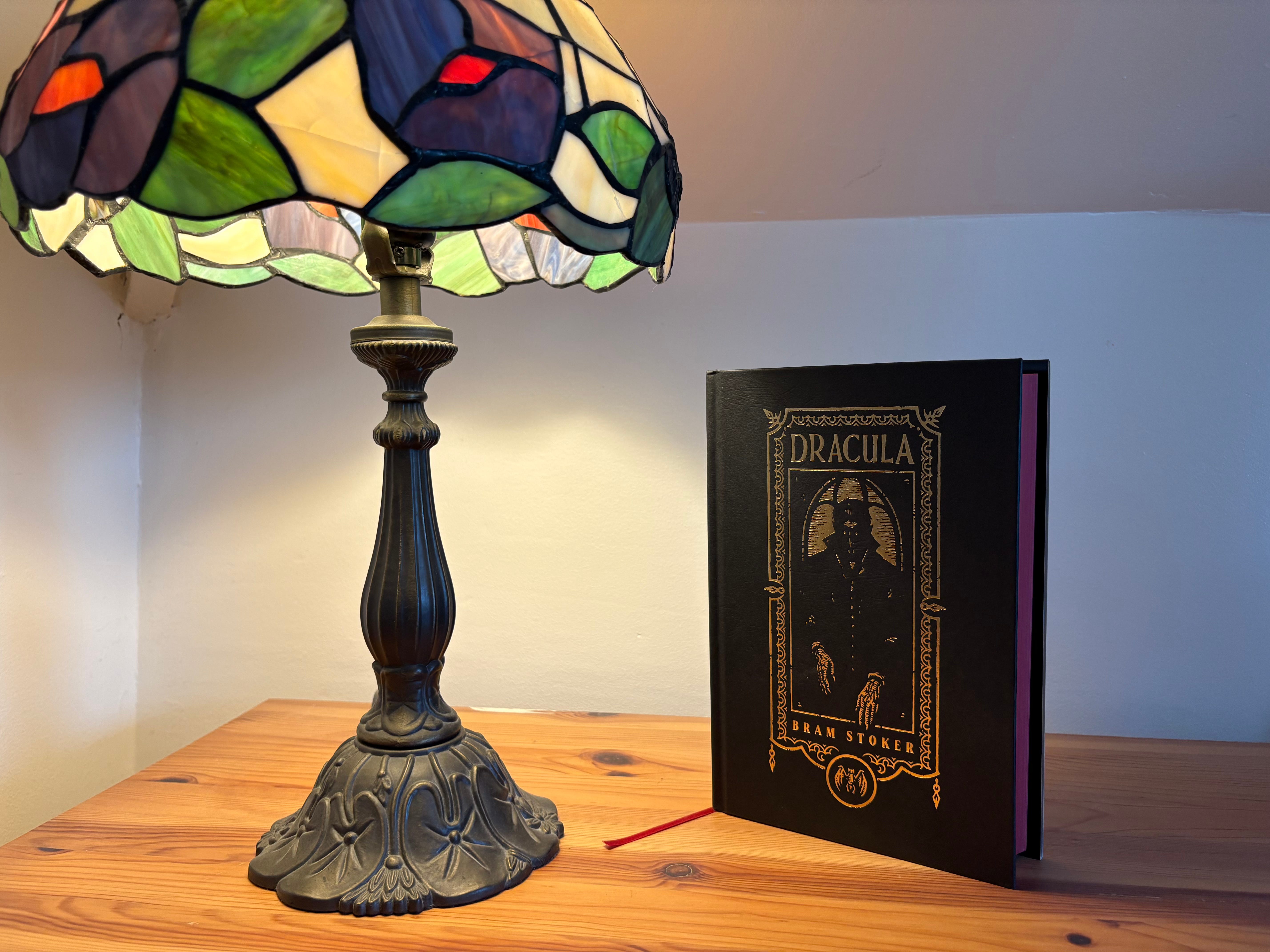
My edition is beautiful, but I cannot recommend you buy it. In my emotional turmoil on discovering that I was reading a children’s abridged version, I bought the most beautiful version I could find (and afford) because I knew it was a keeper.
I settled on the Dracula entry that was part of Harper Muse Classics: The Gothic Chronicles Collection; Harper Collins being a Rupert Murdoch owned subsidiary of News Corp, as my brother in law promptly explained when we were discussing the edition. Thus, I cannot recommend further lining the Islamophobe elite’s wallet with this purchase, unless you find a preowned one of course.
That said, the edition is beautiful. The font is big, which I always appreciate, making the edition reach a chunky 500 pages. I usually read whilst pacing around and so I was also building some biceps reading this one. There are beautifully decorated pull quotes dotted throughout the book that capture the atmosphere of the novel.
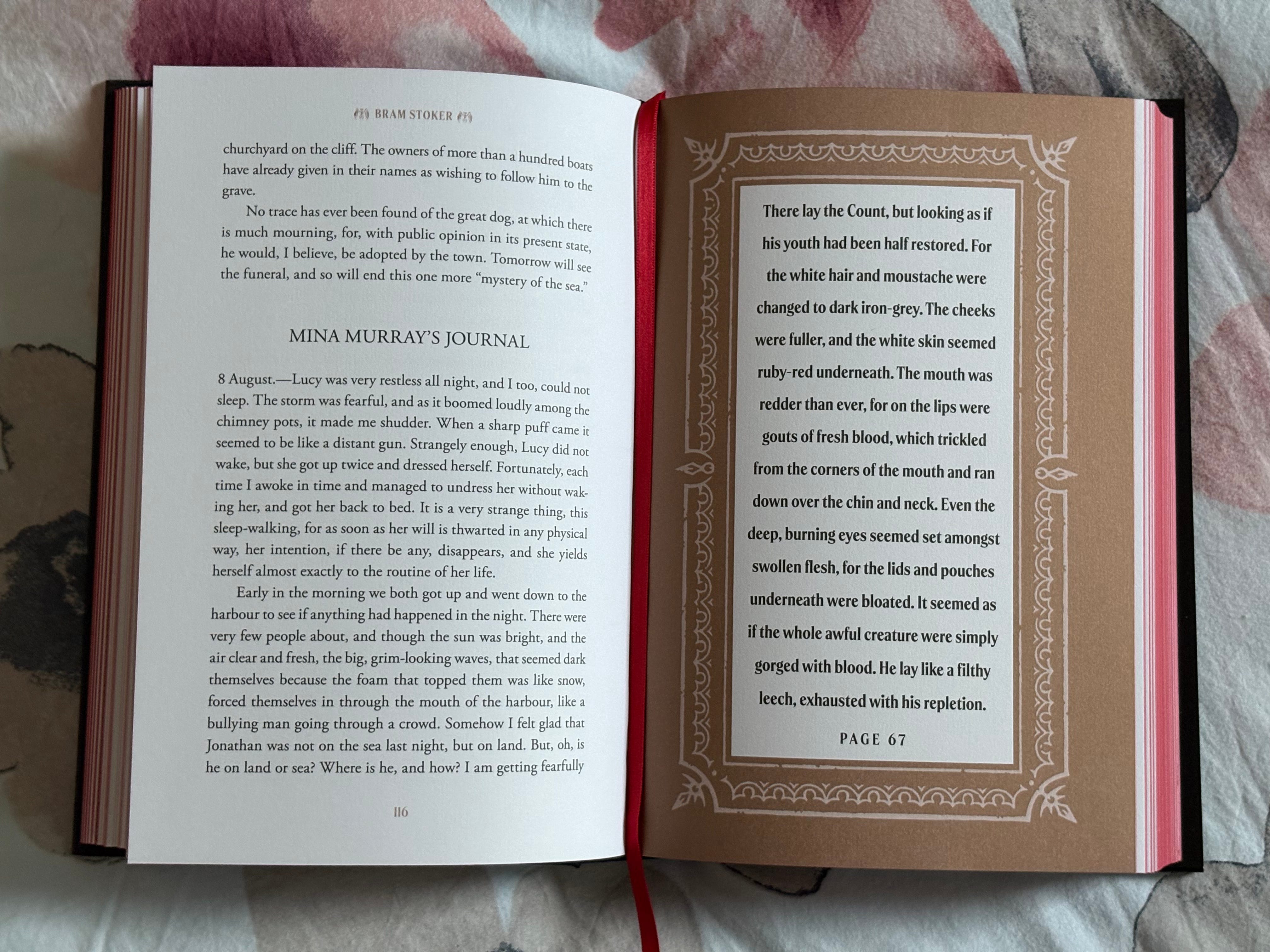
I hope other editions from publishers other than HarperCollins can add this level of presentation to their works, and if I come across any good alternatives I’ll update the post with links to them.
Oh, and here’s the preowned children’s abridged version that I had initially read which was entry 14 in The Children’s Golden Library collection. I don’t recommend it, but in case anyone was curious this was a 2003 publishing which was interestingly bundled with a Daily Mail newspaper purchase in England and Wales. In my defence, I didn’t know “children’s abridged” versions were even a thing, so lesson learned.
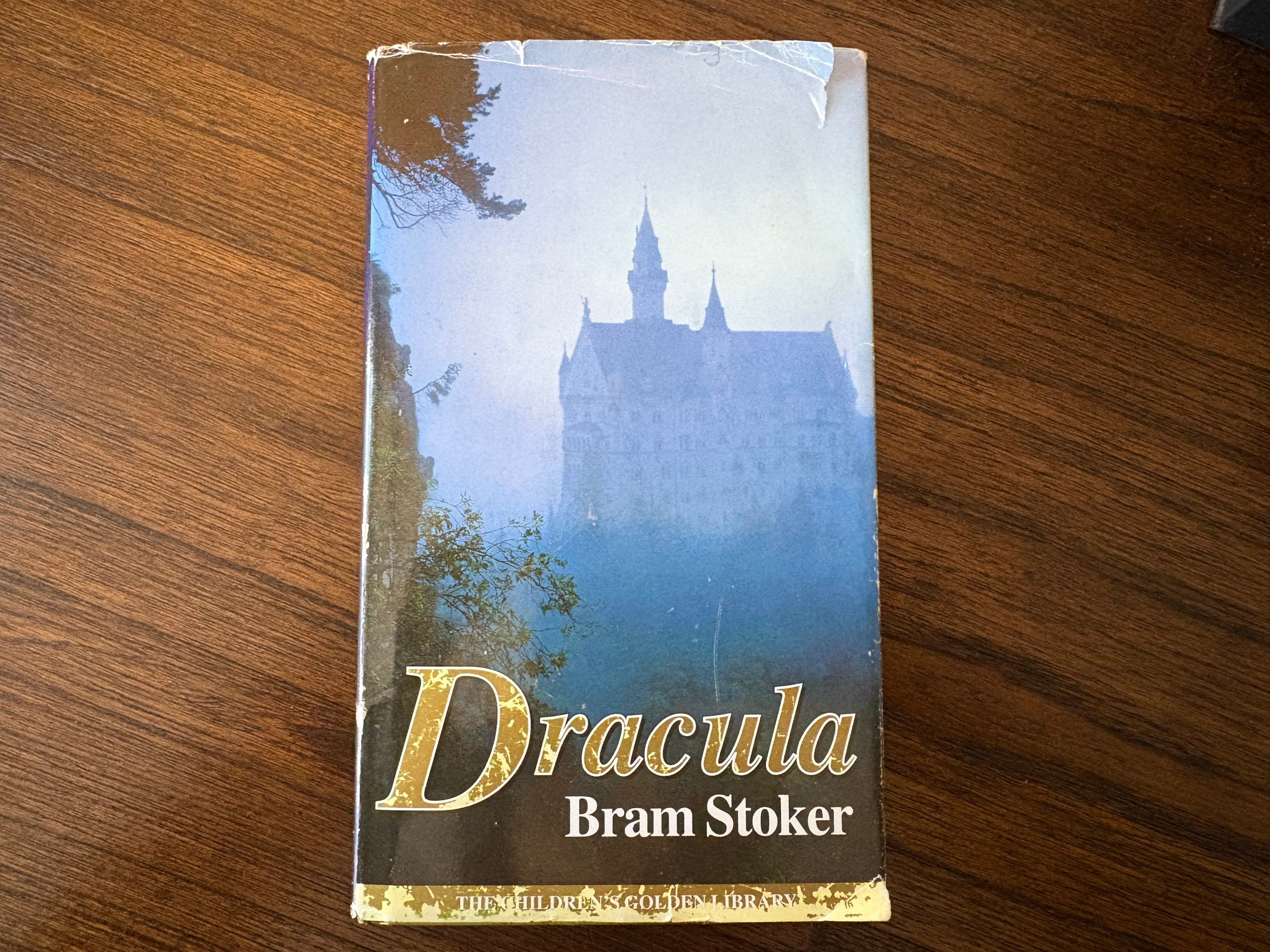
No fancy picture for you 😑 Love the moody cover though.
There seem to a be a small number of children’s abridged versions of Dracula in circulation, some beautifully decorated, so it’s worth double checking when making your purchase.
Get a copy
There is no shortage of Dracula copies and variant floating around in the new and used book markets; every major book retailer sells them. Pick what is calling to you.
Given the copyright expired in the UK and US, you can also legally read it for free if you prefer the digital experience. Download it for your devices at Project Gutenburg.
Interestingly, I happened upon a Substack newsletter that mails the epistolary novel piece by piece on the actual date of the journal entries, telegrams, and letters. This is something I am looking forward to myself as I wait for the first entry on 3rd May, with the story ending on 7th November. You may have to wait until this run ends before subscribing to catch the story from the beginning. Find out more on Dracula Daily.
Unrelated
I starting thinking a little more about the rating system and how I want to use it. Ultimately I decided that I wanted my ratings to represent primarily the feelings I had toward the book and so I gave it the full five stars.
Hope you enjoyed the read. If you did, don’t forget to share the post and if you haven’t already, please check out my original post to see what this publication is all about or peruse my other reviews for anything that piques your interest.
Agree or disagree? Got any suggestions or ideas for the next post?
Contribute to the conversation by leaving a comment. Your feedback helps the community. Contribute to the conversation by leaving a comment and remember to join in on the subscriber chat too.